How it works
From a new listing to the most you should pay: how we find value-add properties, how each one is valued and analysed, what we check, and what an automated analysis can't tell you.
In short
- On paid plans we check estate agents’ new listings in your areas every day, value each home and run it as a flip, BRRR, buy-to-let and HMO on your own assumptions.
- Each strategy gets a verdict against your targets and a maximum offer: the most you could pay and still hit them.
- Every deal in England and Wales is checked for flood zones, conservation areas, listed buildings, national parks and National Landscapes, plus green belt and Article 4 in England, from our monthly copies of official maps.
- It’s an estimate from adverts and public data: we can’t see inside the home, so get a survey, legal advice and builders’ quotes before you commit.
1. Discovery and screening
You save a search: a postcode and radius, your budget, bedrooms, property types and the strategies you run. Live search covers any postcode in England and Wales on Pro and Priority: when you save a search we load that area’s value-add listings, usually within a few minutes. HMO figures need local room rents, and green belt and Article 4 areas aren’t checked in Wales. After that, we check for new listings every day.
We look for value-add stock already advertised by estate agents: unmodernised, reduced, repossessed, short-lease and slow-to-sell homes, and auction lots. Lots usually sell above their guide, so we analyse one at the guide plus 20%, or 80% of our value of the home as it is if that's higher, never at the guide alone (both are defaults you can change in your assumptions). Listings that can't be modelled as an investment, such as shared ownership or retirement homes, are flagged rather than scored.
2. Valuation and analysis
Each home gets an estimated current value from our valuation model, trained on HM Land Registry sales matched to energy certificates, with a likely range: in testing, 8 in 10 homes sold inside it. Its confidence level comes from how narrow that range is. Good: typically within about ±7% of the sale price. Fair: about ±11%. Low: wider than that (about ±18%). We publish how accurate our valuations are, tested on 593,000 sales: see the results.
The value is a starting point to check against the comparable sales shown on each deal, not a formal valuation. Shortlisted deals also get an independent automated valuation as a second opinion.
Then every deal is run as a flip, a BRRR, a buy-to-let and, for 3+ bedroom houses where local room rents are available, an HMO, with stamp duty, fees, refurb, finance, lender stress tests and an after-tax estimate, all on your own assumptions. Each strategy gets a verdict against your targets, and the deal gets a score from 0 to 100 to rank it against the others. How the score and verdicts are worked out, including what a strong verdict must pass and every rule change.
The refurb is estimated from the scope of works the advert suggests (light, medium or heavy), a cost per m² of floor area, any items outside that scope (a roof, windows, damp) and a contingency. The floor area is the energy certificate's, else the advert's, else a typical size for similar homes on the same street, else a typical size for the bedrooms (the deal then says the works are estimated from a typical size). Costs are at UK rates, higher in London (×1.20), the South East (×1.08) and the East of England (×1.03), where building costs more; other regions use UK rates until their build costs are verified. You can change the rates in your assumptions.
Each deal page shows three things separately: how attractive the numbers look, how much evidence is behind them, and the risks, so good-looking numbers on thin data never read as well-supported ones.
3. The maximum offer
For each strategy we work backwards from your target (a margin on the value after works, money left in after a refinance, or a return on cash) to the highest price that still hits it, with stamp duty and finance recalculated at each price. It's where you walk away, not what to offer. Try the maximum offer calculator.
4. Risk checks
One “check first” list on every deal: cash buyers only, lease length, small flats and studios that lenders restrict and auction terms, from the advert, and these map checks, in England and Wales. Green belt and Article 4 areas aren't checked in Wales: there's no national map of them.
| Check | Source (England; Wales) | How it shows |
|---|---|---|
| Flood zone 3 | Environment Agency; Natural Resources Wales | Red warning: high probability of flooding from rivers or the sea |
| Flood zone 2 | Environment Agency; Natural Resources Wales | Amber: medium probability of flooding |
| Conservation area | Historic England and councils; Welsh Government and councils | Amber: outside changes may need planning permission |
| Listed building within 25 m | Historic England (National Heritage List for England); Cadw | Amber: check whether this home is listed |
| Green belt, AONB or national park | Councils (green belt), Natural England (AONBs), ONS (national parks); Natural Resources Wales (AONBs and national parks; green belt not checked in Wales) | Amber: stricter rules for extensions and new buildings |
| Article 4 direction | Councils, plus known HMO Article 4 areas; not checked in Wales (HMO conversions need permission everywhere there) | A note on the deal and PDF (not a warning): some permitted development rights, often HMO conversions, are removed |
We check against our own copies of the official maps, refreshed every month: the Environment Agency's Flood Map for Planning (Flood Zones 2 and 3, flooding from rivers or the sea), and the government planning data platform's files for conservation areas, listed buildings (Historic England), green belt, AONBs (Natural England), national parks and Article 4 directions. In Wales, from DataMapWales (the Welsh Government's map service): Natural Resources Wales's Flood Map for Planning (rivers and the sea), Cadw's listed buildings, conservation areas, and Natural Resources Wales's national parks and AONBs. Each deal's risk panel says when it was checked and how current each source is. In Wales, converting a home to an HMO needs planning permission everywhere, so Welsh deals say that instead of checking Article 4.
When the planning maps are unavailable
Since 13 Nov 2026 we check against our own copies of the maps, so an outage of the government's planning data service (planning.data.gov.uk), like the one from 6 Nov 2026, no longer stops the checks. If a copy can't be refreshed, we keep using the last good one, and each deal shows how current its sources are.
If a check can't run at all, the deal says “Planning maps unavailable” and names what wasn't checked, so it hasn't been cleared of those risks. We check it again automatically, usually within the hour. Until then, check conservation area and listed building status with the council. Each deal page and PDF deal pack has the full note.
5. Plans, checks and alerts
On Free, you get the deal calculators and your top 3 deals from your saved search, refreshed every Monday: full analysis and PDF deal pack, from listings we already hold in your area (the full ranked feed, daily digest, alerts and other areas are on the paid plans). Free searches don't load new areas or fetch listings of their own: your preview is picked each Monday from listings we already hold, and we email it to you (you can turn the email off). The 3 deals include the same risk checks as every deal (flood, planning and lease), and a deal with a serious risk, such as flood zone 3 or a lease under 80 years, is never one of them.
How often we check your areas for new listings: on Pro, once a day. On Priority, once a day and also through the day, from 7am to 10pm.
On Pro, your best new matches arrive in a daily digest at 7am. Priority adds same-day alerts: we check for new listings in your areas through the day, from 7am to 10pm, and send the strongest by email, text or push notification as soon as they're analysed. On Priority, you also get price-drop and sold STC alerts on deals on your Shortlist (Watching or Viewed).
6. Your criteria and assumptions
Purchase costs, refurb rates, bridging and mortgage terms, target margins and returns: every figure follows from assumptions you control, starting from sensible defaults. Change one and every deal is re-run. You can say which strategies you want, and hide deals with risks you'd rather avoid.
7. Local market data
Every postcode district with enough sales has a guide: sold prices and how they've moved, rents and yields, HMO room rents where known, and current deals. Browse the area guides.
What an automated analysis can’t tell you
We can't see inside the home. Condition, structural problems, damp, title, planning history, the lease's detail and the true cost of works can all move the numbers a long way. Get a survey, legal advice and builders' quotes before you commit money. Everything here is an estimate, not valuation, tax or financial advice. where our data comes from.
See it in action
What you get every morning.
Explore the demo (made-up listings)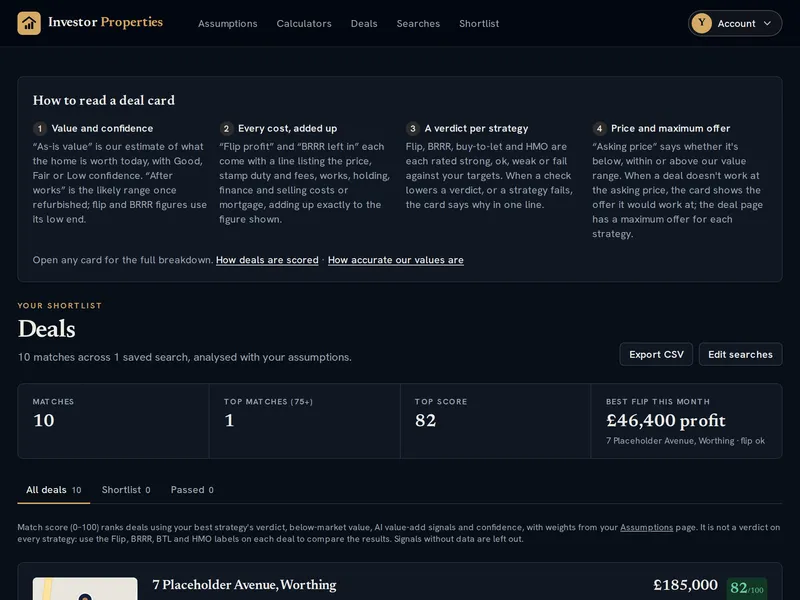
Your pre-screened deal feed
New value-add listings in your areas, already screened and ranked: warnings first, then flip profit, BRRR money left in, how far below our estimate the price is, and a verdict for each strategy.
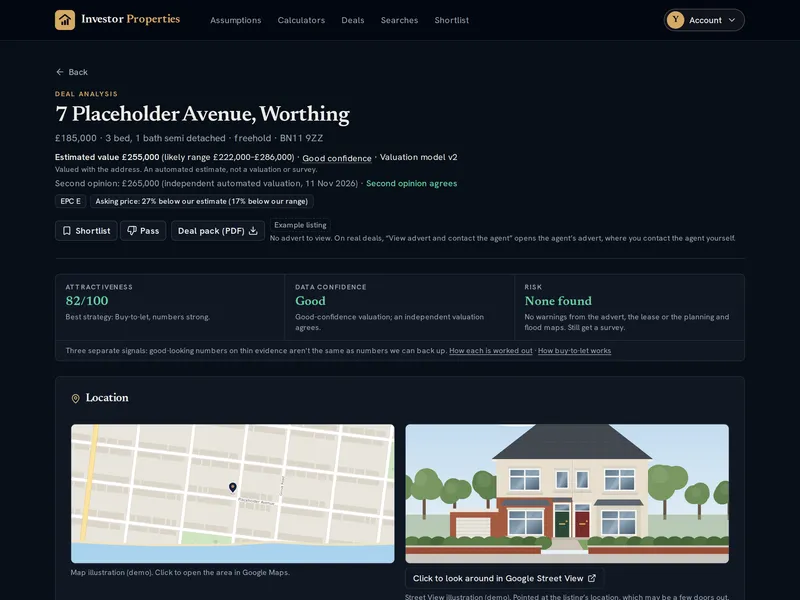
Risk checks and a maximum offer on every deal
What to check first, the most you could offer for each strategy to hit your targets, our starting estimate with its likely range and the comparable sales behind it, and figures you can change as you go.

The 7am daily digest
Your best new matches in one email each morning. Same-day alerts on Priority are separate: they arrive through the day, as soon as a strong deal is analysed.
Screenshots use made-up demo properties.
What's included, and on which plan
Automated discovery
New value-add listings in your saved areas every day, surfaced and pre-screened against your budget, property types and strategies.
Pro and Priority
Price reductions
Reduced listings come into your feed with their price history, and you get price-drop and sold STC alerts on deals on your Shortlist (Watching or Viewed).
Feed: Pro; alerts: Priority
Value-add, repossessions and auctions
Unmodernised, repossessed, short-lease and slow-to-sell listings. Auction lots are analysed at the guide plus a typical uplift, never at the guide alone.
Pro and Priority
Investment calculators
Flip, BRRR, buy-to-let and HMO numbers with stamp duty, finance, refurb and an after-tax estimate. Share any deal with a link.
Free
Maximum offer
The most you could pay for each strategy and still hit your target margin, return or cashflow, on every deal and in the calculator.
All plans
Area research
A guide to every postcode district with enough sales: sold prices, rents, yields and a typical deal, from Land Registry, ONS and EPC data.
Free
Risk checks on every deal
One list of what to check first: cash buyers only, lease length, small flats, auction terms, plus flood zone, conservation area and listed buildings in England and Wales.
Pro and Priority
Daily digest and same-day alerts
A 7am digest of your best new matches, and on Priority, alerts by email, text or push as soon as a strong deal is analysed.
Digest: Pro; same-day: Priority
Your own criteria
Your purchase costs, refurb rates, finance and target returns drive every figure. Change one and every deal is re-run.
All plans
Shortlist
Track deals as Watching, Viewed, Offer made or Rejected, with private notes.
Pro and Priority
PDF deal packs
A branded PDF of a deal, with every figure, warning and note, to keep or share with your broker. CSV exports of your feed are on Priority.
All plans: every deal on Pro and Priority; Free: your 3 weekly deals
Refer a friend
A free month for each friend who subscribes, up to 12 a year. On Free, it’s a month of Pro when you upgrade.
All plans